
At its core, all data falls into one of two buckets: quantitative or qualitative. Nailing this distinction is the first step in any sound research, so let’s clear it up.
Quantitative data is anything you can count. It’s measurable, numerical, and objective. But this type of data mostly answers questions like how many or how much.
Qualitative data, on the other hand, is descriptive and all about context. It explains the why behind the numbers… and is often found in text, observations, or open-ended chats.
Quantitative vs. Qualitative Research
A simple product review is a perfect real-world example. The 2-star rating a customer leaves? That’s clean, straightforward quantitative data. It’s a number. Simple.
But the written comment explaining why they gave it only two stars – “the user interface is confusing” – is the rich qualitative data. One gives you a hard number, and the other provides the story behind it.
This difference is super crucial in practice. The numbers tell you what is happening, but the narrative tells you why.
Imagine a business sees that 35% of users abandon their shopping cart. That’s a vital quantitative metric, but it doesn’t really solve the problem, does it? To find a solution, they need qualitative insights from user interviews or feedback forms, which might reveal that the “checkout button is hard to find.”
Choosing the right approach depends entirely on your goal. Are you trying to measure a specific, known variable, or are you trying to explore a topic to understand it more deeply? Your answer points directly to the type of data you need.
Let’s break down the key differences.
Quick Comparison Quantitative vs Qualitative Data
For a quick reference, this table summarizes the fundamental differences between quantitative and qualitative data.
| Aspect | Quantitative Data | Qualitative Data |
|---|---|---|
| Nature | Numerical, measurable, and objective. | Descriptive, contextual, and subjective. |
| Answers | “How many,” “How much,” “How often.” | “Why,” “How,” “In what way.” |
| Examples | 500 clicks, 4.5-star rating, 75% market share. | Interview transcripts, focus group notes, user feedback. |
| Analysis | Statistical analysis, calculations, modeling. | Thematic analysis, coding, interpretation. |
As you can see, each data type serves a distinct purpose. Quantitative data gives you the scale of a problem or trend… while qualitative data provides the depth and understanding needed to act on it.
Quantitative vs. Qualitative Research Methods

So, how do you actually get your hands on this data? The method you choose isn’t arbitrary; it flows directly from the questions you’re trying to answer. You have to match the tool to the task at hand. It’s just that simple.
Quantitative research is all about structure and scale. You use it when you have a specific hypothesis to test or need to measure trends across a large audience. And the goal is to collect objective, numerical data that can be analyzed for statistical significance.
Collecting Hard Numbers
When you need to measure, compare, and prove something with numbers, you turn to quantitative methods. These are typically structured and easy to scale.
A few go-to quantitative methods are:
- Surveys with closed-ended questions: Think multiple-choice, rating scales (e.g., 1-5), or yes/no questions. These are incredibly efficient for gathering a high volume of data.
- A/B Tests: This is a classic controlled experiment. You show two different versions of a webpage or email to different users to see which one performs better on a specific metric, like click-through rate.
- Website Analytics: Tools like Google Analytics give you a constant stream of hard data, tracking user behaviors like bounce rates, time on page, and conversion funnels.
But what happens when you don’t even know which questions to ask? Or when the numbers don’t tell you the why behind the behavior?
Digging for Deeper Insights
That’s where qualitative research comes into play. It’s exploratory and designed to uncover motivations, opinions, and the complexities of human experience. Instead of surveying thousands, you might speak to just a handful of people to gather rich, detailed insights.
The point isn’t to get a number that represents everyone. It’s to uncover the story and context from a few key individuals. This is how you discover the “unknown unknowns”… the ideas you never would have thought to ask about.
Qualitative methods are far more personal and flexible.
For example, you might conduct:
- In-depth interviews: These are one-on-one conversations that allow you to probe deeper with follow-up questions and really understand someone’s thought process.
- Focus groups: A moderated discussion with a small group of people helps you see how different viewpoints interact and build on one another.
- Ethnographic studies: This involves observing people in their natural environment – using your product at home, for instance – to see how they actually behave, not just how they say they behave.
Ultimately, your choice of research method sets the stage for everything that follows. You have to decide from the start if you’re trying to build a case with numbers or explore a mystery through stories.
Comparing the Key Characteristics of Each Data Type
When you get down to it, the real difference between qualitative and quantitative data comes down to what you’re trying to accomplish. One gives you hard numbers, the other gives you the story behind them.
Quantitative data is all about being objective and replicable. Because everything is numerical, you can perform powerful statistical analyses to uncover trends, calculate averages, and prove or disprove a hypothesis with confidence.
Subjective Depth vs. Objective Scale
On the flip side, the major strength of qualitative data is its incredible depth and context.
It’s subjective by design, and that’s its power. It captures the nuances of human experience – the feelings, opinions, and motivations that numbers can never fully represent. Think about it: would you rather have a simple 3-star rating, or a detailed review that explains exactly what a customer loved or hated?
Analyzing this kind of data is more of an art. It involves interpretation and skill to tease out the recurring themes, patterns, and insights buried in the text.
Here’s the simplest way to remember it: Quantitative data tells you what happened. Qualitative data explains why it happened.
From a purely statistical standpoint, the distinction is even sharper. You can’t run the same kind of mathematical analysis on opinions as you can on numbers. This is why quantitative results are replicable around 90% of the time, a standard that’s nearly impossible to meet with subjective interviews.
To get the full picture, you almost always need a blend of both. The numbers tell you where to look, and the stories tell you what you’re looking at.
How to Collect and Analyze Research Data
This is where the rubber meets the road. Once you know what kind of data you need, you have to actually go out and get it – and the methods for quantitative and qualitative data couldn’t be more different.
When you’re after quantitative data similar to calculating the 5 number summary, you’ll lean on structured methods that can be easily scaled. Think online surveys with multiple-choice questions, quick polls, or pulling hard numbers directly from your website analytics. The whole process is designed to be systematic and repeatable.
Analyzing the numbers is just as structured. You’ll fire up statistical software to turn all that raw data into meaningful insights. The goal here is pure objectivity: finding patterns that hold up to mathematical scrutiny.
Making Sense of the Numbers – Interpreting the Human Element
Gathering qualitative data, on the other hand, is a much more personal, hands-on affair.
You’ll be using methods like one-on-one interviews, running focus groups, or conducting direct observations to see how people behave in their natural environment. To get the most out of these non-numerical insights, it helps to master various qualitative data collection techniques.
Analyzing this kind of data feels more like an art than a science. It’s often a manual process of sifting through notes, pulling out impactful quotes, and “coding” the information by grouping it into themes. You’re not counting things; you’re interpreting meaning to piece together a compelling story. And knowing which approach to take is what separates good research from great research.
So, how do you decide which type of data to use? The qualitative vs quantitative data debate isn’t about picking a winner – it’s about choosing the right tool for the job. Your research question is your guide.
If you need to measure, compare, or test something on a large scale, you’re looking for quantitative data. Numbers give you the hard evidence to spot trends, validate a hypothesis, or see if a change had a real impact. It’s all about the what.
But if you need to understand the why behind those numbers, you’ll turn to qualitative data. This is where you dig into people’s motivations, feelings, and experiences to get the rich context that numbers alone can’t capture.
The Power of a Mixed Approach
The real magic often happens when you combine them. One type of data can uncover a problem, and the other can help you understand and solve it.
Think of a game developer trying to figure out why players abandon a specific level. They could start with qualitative interviews to hear players describe their frustrations in their own words (the why). Once they have a theory – say, the controls are confusing – they can redesign the interface and then use quantitative data to track whether fewer players are quitting (the what).
You start with the why (qualitative) and then confirm the fix works at scale with the what (quantitative). It’s a killer combo.
This decision tree gives you a great visual for when to lean one way or the other. Are you trying to measure an experiment or understand a concept? Your answer points you in the right direction.
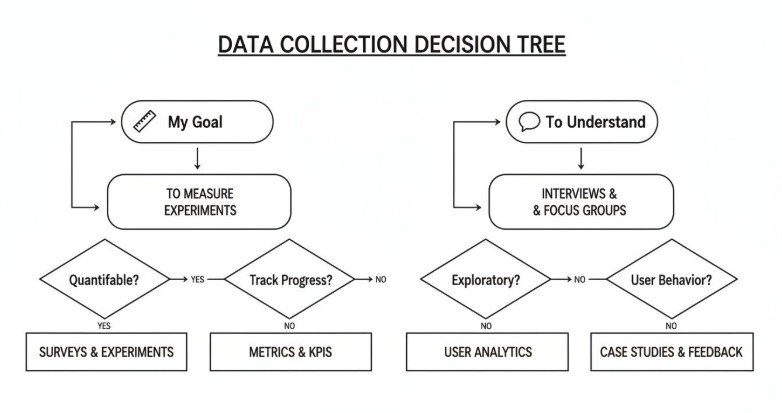
Ultimately, if your goal is to measure and validate, numbers are your go-to. If you need to explore and understand context, qualitative insights are what you’re after.
Data in the Real World
Let’s look at a retail example. A company wants to see which of two new store layouts performs better. They use quantitative data like sales figures and foot traffic patterns from A/B tests to get a definitive answer on which layout brings in more money.
At the same time, they use qualitative data from in-store observations and brief customer interviews. This helps them understand why one layout felt more inviting or was easier to shop in. The numbers prove what worked, but the stories explain why it worked.
Large-scale quantitative analysis can reveal patterns that are impossible to see otherwise. A 2019 analysis of 4,000 cities, for instance, used metrics like population and land area to uncover universal laws of urban growth. Gathering this kind of raw information can even involve learning how to scrape website data.
With that data in hand, a researcher could analyze city GDP datasets (n=500), with values from $1B to $2T, and then find the core trends. This kind of statistical work could spot outliers caused by events like the 2008 financial crash with 40% greater accuracy than just reading through qualitative reports. You can dive deeper into this fascinating study on urban patterns at Frontiers in Digital Humanities.
Common Questions About Research Data
As you start working with qualitative and quantitative data, a few practical questions almost always come up. Let’s tackle some of the most common ones I hear from people trying to get their research off the ground.
Can You Turn Qualitative Data into Numbers?
You absolutely can, and it’s a process we call quantification. It’s a handy trick for getting a bird’s-eye view of your qualitative findings.
Essentially, you take unstructured data like open-ended survey answers or interview transcripts and assign them to predefined categories. For example, you could comb through customer feedback and sort comments into buckets like ‘Positive Experience,’ ‘Negative Experience,’ and ‘Neutral.’ Then, you just tally up the results to see the distribution.
Just be aware of the trade-off. While this can help you spot high-level patterns, you’re intentionally stripping away the context and emotion that makes qualitative data so rich. You get a number, but you might lose the story behind it.
Is One Data Type Better Than the Other?
Honestly? No. It’s like asking whether a hammer is better than a screwdriver.
They’re just different tools for different jobs. The “best” one is simply the one that helps you answer your specific research question.
Quantitative data is what you need when you have to measure, validate, or compare things across a large group. But qualitative data is your go-to when you need to dig into motivations, explore new ideas, or understand the why behind people’s actions. The real magic happens when you use both together.
What Are the Main Limitations of Each Data Type?
Every method has its limits, and knowing them upfront saves a lot of headaches. It really boils down to a classic trade-off between breadth and depth.
The biggest challenge with qualitative data is that its findings aren’t easily generalizable. The rich, detailed stories you get from a handful of interviews are incredibly insightful… but they might not reflect the experience of your entire user base. It gives you incredible depth, but not necessarily width.
On the flip side, quantitative data often lacks depth. It’s fantastic for telling you that 30% of users abandoned their cart, but it will never tell you why they got frustrated and left. You get the “what,” but you’re left guessing about the “why.”
This is exactly why a mixed-methods approach is so powerful. One type of data flags an issue, and the other helps you understand its root cause. They fill in each other’s gaps perfectly, giving you a much more complete picture to base your decisions on. It’s not about choosing a side in the qualitative vs. quantitative data debate – it’s about using both to win.